

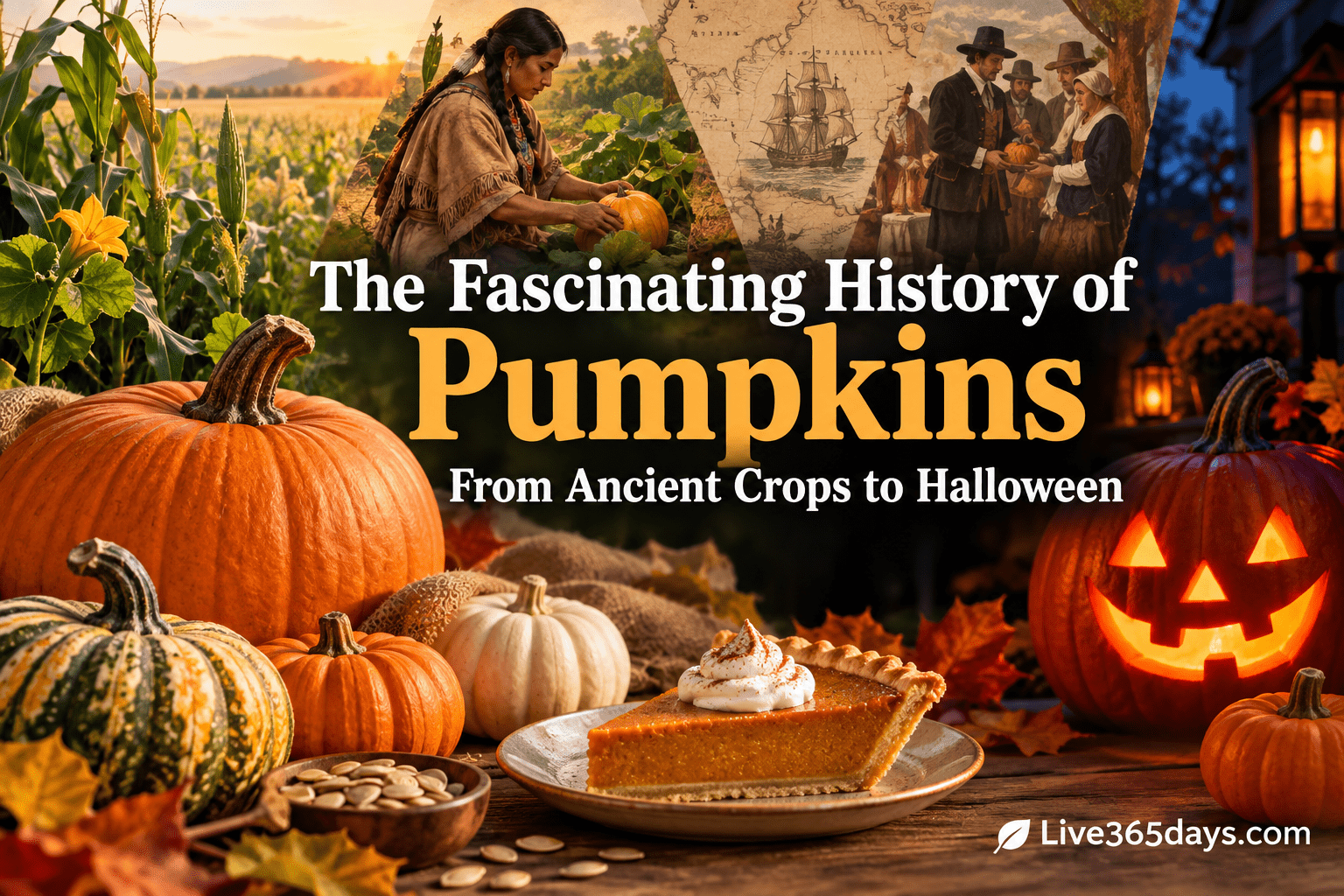
Every autumn, pumpkins appear everywhere—on kitchen tables, in markets, farms, festivals and front porches. They become pies, soups, breads and decorations, while carved pumpkins light up Halloween celebrations.
But pumpkins are much more than a symbol of autumn.
Their story stretches back thousands of years across the Americas. Long before pumpkin pie and jack-o-lanterns became familiar traditions, Indigenous peoples cultivated squash as an important food crop and incorporated it into sophisticated agricultural systems.
So, where did pumpkins come from, and how did they become such an important part of modern culture?
Let’s explore the fascinating history of pumpkins.
Where Did Pumpkins Come From?
Pumpkins belong to the squash family and are native to the Americas. Archaeological evidence shows that squash was among the early plants domesticated by people in the Americas, with cultivation dating back thousands of years.
The earliest forms were very different from the large, bright-orange pumpkins commonly seen today. Over generations of cultivation and selection, people developed varieties with different sizes, shapes, textures and flavors.
Pumpkins and other squashes became valuable because they were nutritious, versatile and could be stored for later use. Their importance extended beyond food—they became part of agricultural knowledge, seasonal traditions and cultural practices.
The Smithsonian notes that squashes were important dietary and cultural staples for ancient communities in Mesoamerica and that the plants people cultivated thousands of years ago looked quite different from many modern varieties.
The Three Sisters: Corn, Beans and Squash
One of the most fascinating chapters in pumpkin history is connected to the agricultural tradition commonly known as the Three Sisters.
In this system, corn, beans and squash were grown together. Different Indigenous nations developed and adapted versions of this practice to their own environments and traditions.
The three crops complemented one another.
- Corn could provide a natural structure for climbing bean plants.
- Beans contributed nitrogen to the soil through their relationship with nitrogen-fixing bacteria.
- Squash and pumpkin leaves spread across the ground, helping suppress weeds and reduce evaporation.
The U.S. Department of Agriculture’s National Agricultural Library describes the Three Sisters as more than an agricultural technique. It is also a cultural and spiritual tradition with different meanings and stories among Indigenous communities.
This is an important reminder that traditional agriculture was not simply about growing food. It could combine ecological knowledge, nutrition, community practices and cultural identity.
The Story Behind the Name “Pumpkin”
The word pumpkin has a long linguistic journey.
The HubPages article traces the word through the Greek pepon, associated with a large melon, followed by French and English forms before the modern word “pumpkin” emerged.
However, the historical terminology was not always referring specifically to the modern pumpkin varieties we recognize today. Words such as pompon and pumpion were used for melon-like fruits and related gourds.
As European settlers encountered unfamiliar plants in the Americas, existing European words and new American crops became intertwined.
Language, like food, changed as cultures met.
How Indigenous Peoples Used Pumpkins and Squash
For Indigenous communities, squash was not simply an autumn decoration.
Different communities developed many ways of preparing and preserving squash. It could be cooked, roasted, dried and incorporated into meals.
The Three Sisters agricultural system also helped provide complementary crops from the same growing area. Historical research documents a wide range of foods prepared from corn, beans and squash among Indigenous communities in parts of northeastern North America.
This agricultural heritage is particularly significant because it demonstrates how traditional food systems could be adapted to local environments while providing diverse sources of nutrition.
How Pumpkin Became Part of European-American Cuisine
When Europeans arrived in the Americas, they encountered crops that were unfamiliar in Europe. Pumpkins and other squashes eventually crossed the Atlantic as part of the Columbian Exchange.
European cooks began experimenting with these new ingredients.
Pumpkin was cooked in different ways, including as a vegetable and in dishes resembling pies. Early versions were not necessarily the sweet, smooth custard pies that many people associate with Thanksgiving today.
Historical records show that pumpkin dishes evolved considerably over time.
The Library of Congress notes that seventeenth-century pumpkin pies could contain sliced pumpkin combined with sugar, spices and other ingredients. By the late eighteenth century, recipes had moved closer to the pumpkin pie familiar today.
The Evolution of Pumpkin Pie
So, who invented pumpkin pie?
There isn’t a single inventor.
Instead, pumpkin pie developed gradually through the interaction of Indigenous American crops and European culinary traditions.
Early recipes varied enormously. Some involved pumpkin cooked with milk and spices, while other preparations used pumpkin alongside apples or other ingredients.
One particularly interesting early method involved cooking a filled pumpkin rather than placing pumpkin custard inside a conventional pastry crust.
Over time, cooks developed more recognizable pie recipes.
In 1796, Amelia Simmons’ American Cookery included pumpkin pie recipes, helping establish pumpkin pie as part of the developing American culinary tradition.
Today, pumpkin pie is strongly associated with Thanksgiving in the United States, but its history is actually a story of agricultural exchange, adaptation and culinary experimentation.
How Pumpkins Became Jack-o-Lanterns
Perhaps no pumpkin tradition is more recognizable than the jack-o-lantern.
But pumpkins were not the original vegetables used for Halloween lanterns.
The tradition of carving lanterns developed in Ireland and other parts of the British Isles, where people carved vegetables such as turnips and placed lights inside them.
Irish immigrants brought the tradition to North America.
There, they discovered pumpkins—larger, softer and generally easier to carve than turnips.
The pumpkin gradually became the preferred material for Halloween lanterns in North America.
Today, the carved pumpkin is one of the world’s most recognizable Halloween symbols.
From Farm Crop to Global Autumn Symbol
The transformation of the pumpkin is remarkable.
It began as an important crop cultivated by Indigenous peoples of the Americas. Over centuries, it became part of European-American cuisine and eventually developed into a major cultural symbol.
Today, pumpkins appear in:
- Halloween decorations
- Thanksgiving meals
- Pumpkin pies
- Soups and curries
- Breads and cakes
- Seeds and snacks
- Farm festivals
- Autumn markets
- Seasonal beverages
- Agricultural fairs
The pumpkin has therefore become much more than a food.
It represents harvest, seasonal change, farming, creativity and celebration.
Pumpkins and Sustainable Agriculture
The history of pumpkins also offers an interesting lesson for modern agriculture.
The Three Sisters approach demonstrates how different crops can complement one another rather than always being grown in isolation.
Modern agriculture faces challenges involving soil degradation, water availability, biodiversity and climate change. Traditional agricultural knowledge can provide useful ideas for thinking about crop diversity, ground cover and resource efficiency—although traditional systems should be understood within their specific cultural and ecological contexts rather than treated as one universal farming formula.
The Three Sisters model remains an important example of agricultural knowledge that connects food production with ecological relationships.
Are Pumpkins a Fruit or a Vegetable?
Here’s a fun fact: botanically, a pumpkin is a fruit.
Why?
Because it develops from the flower of the plant and contains seeds.
In everyday cooking, however, pumpkins are generally treated as vegetables because of how they are prepared and served.
This is one of those fascinating cases where botanical classification and culinary classification don’t quite agree.
Why Do Pumpkins Have So Many Different Shapes and Colors?
The familiar orange pumpkin is only one form.
Pumpkins and related squashes can be:
- Orange
- White
- Green
- Yellow
- Striped
- Small and round
- Long and cylindrical
- Giant and heavy
Farmers and gardeners have selected pumpkin varieties for different characteristics over generations, including flavor, size, storage ability, appearance and suitability for carving.
The enormous variety we see today is therefore the result of both natural diversity and human cultivation.
What Makes Pumpkin History So Fascinating?
The history of pumpkins tells a much bigger story than the history of one crop.
It connects:
Indigenous agriculture → crop domestication → cultural traditions → global food exchange → culinary innovation → Halloween
It also reminds us that many foods we consider ordinary have extraordinary histories.
The pumpkin sitting on a doorstep may look simple, but behind it lies thousands of years of farming, adaptation and cultural exchange.
Frequently Asked Questions About Pumpkin History
Where did pumpkins originate?
Pumpkins and related squashes originated in the Americas and were cultivated by Indigenous peoples thousands of years ago.
What are the Three Sisters?
The Three Sisters refers to an Indigenous agricultural system involving corn, beans and squash. Different Indigenous nations developed their own versions and cultural traditions surrounding the crops.
Who invented pumpkin pie?
There was no single inventor. Pumpkin pie developed gradually through the combination of Indigenous American pumpkins and European culinary traditions.
Why are pumpkins associated with Halloween?
Pumpkin carving developed in North America from older European traditions of carving vegetables such as turnips into lanterns. Pumpkins were larger and easier to carve, helping them become the iconic Halloween lantern.
Is pumpkin a fruit?
Yes. Botanically, pumpkin is a fruit because it develops from a flower and contains seeds.
Final Thoughts
From ancient fields to modern Halloween celebrations, the pumpkin has travelled an extraordinary cultural journey.
It began as an important crop in the Americas, became part of Indigenous agricultural traditions such as the Three Sisters, crossed oceans through the exchange of crops and ideas, entered European-American cuisine and eventually became a global symbol of autumn.
The next time you see a pumpkin, remember that you’re looking at more than a seasonal decoration.
You’re looking at a small piece of agricultural and cultural history.
What we grow, cook and celebrate today is often connected to stories that began thousands of years ago.
At Live365days, we believe that discovering these stories helps us appreciate food, nature, culture and the world around us a little more deeply.
Leave a Reply